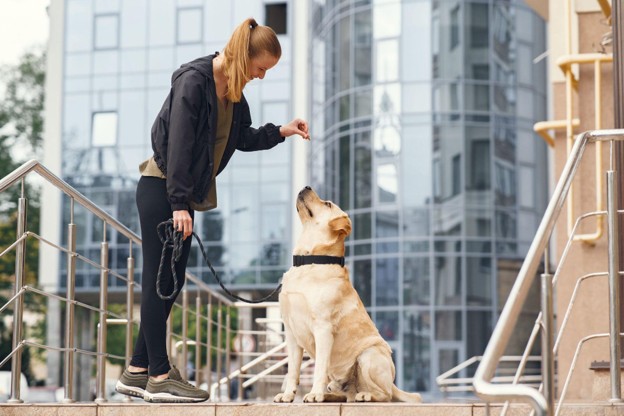
A dog may follow directions perfectly in the living room and seem to forget them outside. Marissa Corbett brings attention to an important part of dog training: learning a behavior in one environment does not automatically make that behavior reliable everywhere.
This difference can confuse owners. A dog that consistently sits, stays, or comes when called at home may struggle with the same request at a park, on a busy sidewalk, or around unfamiliar dogs. The behavior has not necessarily disappeared. Instead, the environment has become more challenging.
Dogs Learn Behaviors Within a Particular Context
People can often apply familiar information to a new situation without much deliberate practice. Dogs may need more repetition before making the same connection.
Consider a dog that learns “sit” during training sessions in the kitchen. The environment is predictable. The floor, sounds, people, and surrounding smells are familiar. There may also be very little competing for the dog’s attention.
Moving that exercise to the front yard changes the situation.
Suddenly there are vehicles, neighbors, birds, unfamiliar smells, movement, and other sounds. The cue may be familiar, but the circumstances surrounding it are not.
This is why practicing a behavior in different environments is an important part of making it more reliable.
Distractions Compete for a Dog’s Attention
A quiet home gives an owner a considerable advantage during training.
Outside, that advantage becomes smaller.
Dogs experience environments through information that people may barely notice. A passing dog, interesting scent, distant sound, moving bicycle, or person approaching from across the street may immediately become more interesting than a familiar command.
That does not automatically indicate stubbornness.
The dog is being asked to perform a learned behavior while processing competing information.
Training around distractions therefore requires realistic expectations. A behavior that is easy in a quiet room can become substantially harder when the surroundings are stimulating.
Increase Difficulty Gradually
One common mistake is moving directly from a quiet training environment to an extremely distracting one.
A dog might perform reliably indoors and then be expected to demonstrate identical behavior at a crowded park.
The difference between those environments can simply be too large.
A more gradual progression could move through locations such as
- A quiet room inside the home.
- Another room with mild household activity.
- A backyard or other familiar outdoor area.
- A quiet residential street.
- A location where people are present at a distance.
- A moderately distracting public environment.
The exact progression will depend on the dog.
The objective is to introduce enough difficulty to encourage learning without making successful responses unrealistic.
Distance Can Make Distractions More Manageable
Training around distractions does not require immediately placing a dog directly beside them.
Distance can be useful.
A dog that cannot focus while another dog is several feet away may respond much better when that dog is farther across an open space.
The distraction still exists, but its intensity has been reduced.
As the dog becomes more comfortable and responsive, the distance can sometimes be decreased gradually.
This approach gives owners another way to adjust training difficulty besides changing locations entirely.
Familiar Commands May Need Reinforcement in New Places
Once a dog performs a behavior reliably at home, owners may naturally assume the learning phase is complete.
Moving into a new environment can require reinforcement again.
That does not mean training has failed.
The dog is learning that the same cue has the same meaning even when the surroundings change.
Practicing in several locations can help strengthen that connection. Over time, the behavior becomes less dependent on one specific setting.
Consistency remains important. If the verbal cue or hand signal constantly changes, the dog is being asked to interpret both a new environment and inconsistent instructions.
Keeping communication clear makes the task easier to understand.
Timing Matters When Reinforcing Behavior
The timing of reinforcement can influence how clearly a dog understands what behavior produced a positive outcome.
If too much time passes between the correct response and reinforcement, the connection may become less obvious.
This becomes especially important in distracting environments, where many things may happen within a few seconds.
Owners should be prepared before asking for the behavior rather than searching for a reward afterward.
Clear timing helps communicate exactly which response is being encouraged.
Organizations such as AB Dog Training can also provide professional guidance for owners working to develop more reliable behavior across different environments and everyday situations.
Keep Training Sessions Realistic
Long sessions are not always better.
A dog practicing around unfamiliar distractions may become mentally tired faster than when training at home. Once focus begins to decline, continuing to repeat commands may create frustration for both the dog and owner.
Shorter sessions can help maintain quality.
Several successful repetitions followed by a break may be more productive than continuing until the dog stops responding consistently.
Ending after progress also allows training to remain manageable rather than turning every outing into a lengthy obedience exercise.
Do Not Repeat a Cue Indefinitely
When a dog does not respond, owners sometimes repeat the same cue several times.
“Sit” becomes “sit, sit, sit”.
Over time, repeated cues can unintentionally teach the dog that responding to the first request is unnecessary.
When a normally familiar behavior suddenly becomes unreliable, it may simply be that the environment is too difficult.
Rather than repeating the cue indefinitely, it may be more useful to reduce the distraction, create additional distance, regain the dog’s attention, or return temporarily to an easier version of the exercise.
The goal is successful communication, not winning a contest of persistence.
Different Skills May Progress at Different Speeds
A dog that can sit reliably around distractions may still struggle with recall.
That difference makes sense because not every behavior requires the same level of self-control.
Coming when called can require a dog to disengage from something highly interesting and move away from it. Staying in position while another dog passes may present another kind of challenge.
Owners should therefore avoid assuming that success with one command means every learned behavior should immediately become equally reliable in public.
Each skill may need its own progression.
Everyday Life Provides Training Opportunities
Formal training sessions are useful, but ordinary routines also create opportunities to practice behaviors in different contexts.
A dog might practice waiting briefly before going through a door, responding to a familiar cue during a walk, or settling calmly in a new environment.
These moments help connect training with daily life.
They also prevent learned behaviors from becoming something that happens only when treats appear and a formal session begins.
The more appropriately varied the practice becomes, the more opportunities a dog has to understand that familiar expectations can apply in different situations.
Know When the Environment Is Too Difficult
Progress does not require forcing a dog through every distraction.
Occasionally the environment is simply too stimulating at that moment.
If a dog cannot focus at all, repeatedly asking for commands may accomplish little. Moving farther away, choosing a quieter location, or trying again another day can be a more productive decision.
This is especially important when safety is involved.
Owners should use appropriate leashes, secure environments, and other management measures rather than relying on an incompletely developed behavior in situations where failure could create risk.
Reliability Develops Through Repetition
A command performed successfully at home is an important beginning, but reliability is built through broader experience.
Dogs need opportunities to practice familiar behaviors around different sights, sounds, smells, people, locations, and manageable distractions.
That process takes time.
Some dogs adapt quickly, while others need more gradual exposure. Progress may also vary depending on the specific behavior being practiced.
The important point is that difficulty outside the home does not automatically mean the dog has forgotten everything it learned.
Final Thoughts
A dog that listens beautifully in the living room but struggles at the park is facing a different training challenge.
The cue may be identical, but the environment is not.
By introducing distractions gradually, practicing in different locations, maintaining consistent cues, using appropriate reinforcement, and adjusting distance when necessary, owners can help dogs apply familiar behaviors in a wider range of situations.
Reliable training is not simply about teaching a dog what a command means once. It involves helping that dog understand that the same expectation can remain relevant even when the world around it becomes much more interesting.